TEST MODE — OTP codes are shown on screen
Skip to content
SolarQuery Start an enquiry
Commercial & Industrial Solar · India

Solar planned around your working day.

A factory roof, warehouse or office campus can be a useful place to generate electricity, but the project has to fit the business beneath it. Share your location, operating hours and energy needs. SolarQuery helps you start a focused conversation with independent commercial and industrial solar providers about design, delivery and ongoing support.

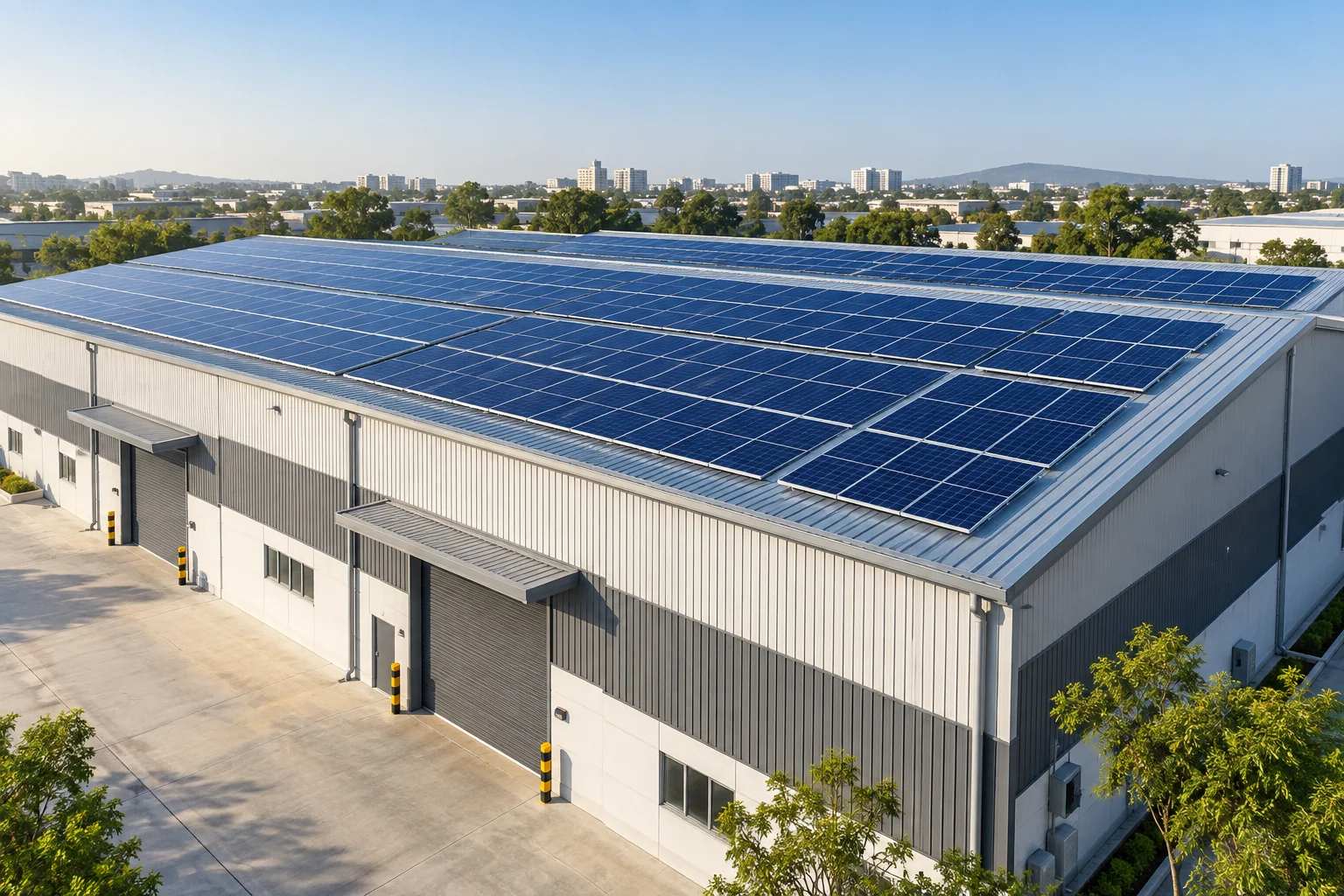
A large rooftop photovoltaic installation on a commercial property.
Factories, warehouses and institutions
Usage-led design and project planning
Provider-led installation and aftercare
Start with the right questions

Start with the load profile. Build a stronger proposal.

Commercial solar works best as a business project with clear technical and commercial assumptions. Your roof area is one input; shift patterns, weekend shutdowns, daytime demand and expansion plans are equally useful. A provider should study how generation will line up with consumption instead of basing the business case only on installed capacity.

SolarQuery helps collect the essentials before connecting you with relevant independent providers where available. You can explore an owned installation, discuss a provider-funded arrangement or request a feasibility review first. Equipment, construction, energy contracts and payments are agreed directly with the provider. Before committing, get a proposal your operations, finance and facilities teams can all understand, including responsibilities that continue after commissioning.

What to include in the brief

A clear scope makes better conversations.

Choose the work you need, then agree the exact responsibilities with your provider.

01 / SCOPE

Consumption and feasibility review

Share bills, interval data where available and an explanation of working hours. The assessment should consider seasonal production, site expansion and weekend loads to identify a suitable initial project scope rather than simply maximise installed capacity.

02 / SCOPE

Roof and structural coordination

Industrial roofs need attention to sheet condition, remaining roof life, access and the underlying structure. Ask how the team will manage skylights, roof warranties, fragile areas and safe routes for routine inspection.

03 / SCOPE

Engineering and delivery planning

A coordinated design sets out panel layout, inverter locations, cable routing and the proposed connection point. The construction plan should explain material storage, lifting operations, working areas and how disruption to normal operations will be managed.

04 / SCOPE

Connection and metering coordination

Ask the provider to identify the relevant approvals and connection studies for your site. Metering, protection settings and export arrangements must reflect the approved project, with responsibilities and dependencies stated in the programme.

05 / SCOPE

Commercial option comparison

Request comparable proposals for ownership or an eligible provider-funded arrangement. Make assumptions visible: generation, self-consumption, tariff changes, export value, maintenance and contract duration. A lower starting payment does not describe the whole commercial commitment.

06 / SCOPE

Operations and performance reporting

Define who monitors the plant, how faults are escalated and what service visits include. Handover should cover drawings, monitoring permissions, training, warranty records and a clear route for planned maintenance or urgent support.

Have a project in mind?

Tell us the location and the work required. Our team can help turn it into a clear enquiry.

Discuss my requirements
Different sites. Different priorities.

Find the approach that fits your project.

Owned rooftop installation

Your business pays for the project and owns the plant, subject to the agreed contract. Compare the complete installation scope and future operating costs, and clarify who carries responsibility for maintenance, insurance and equipment replacement.

Provider-funded on-site solar

Some providers offer an energy purchase arrangement rather than an outright system sale. Availability depends on project eligibility. Review tariff terms, minimum commitments, roof access, early-exit provisions and what happens at the end of the agreement.

Ground space or solar carports

If the roof is unsuitable, assess available ground or parking space. The proposal needs to consider foundations, drainage, vehicle movement and electrical routing. Carports may provide useful shelter, but require a purpose-designed structure.

Solar technicians cleaning and inspecting a rooftop panel array.

A useful proposal connects the work, the site conditions and the responsibilities in writing.

Before you commit

The details worth discussing.

Account for quieter operating days

A system sized to weekday production can export more electricity during holidays or shutdowns. Ask how those periods affect the proposal and whether the financial model uses a realistic operating calendar. More generation does not automatically mean more on-site value.

Include the facilities team early

Roof replacement, fire access, planned machinery and future building work can change the best layout. Give the provider those constraints before drawings are finalised. Agree safe access and shutdown windows with the people responsible for the site.

Separate energy savings from bill savings

Your bill may include demand-related and fixed charges as well as units consumed. Have the provider show which components solar is expected to affect. Review the treatment of exports and avoid a proposal that applies a single saving percentage to everything.

Make accountability visible

Ask which company signs the installation or energy agreement and who performs design, construction and maintenance. Request an agreed acceptance process and written service commitments. If subcontractors are involved, the main contact and responsibility for defects should remain clear.

Cost and scope

Understand what shapes the quotation.

Commercial solar costs depend on the site and the contracting model. Ask for a comparison that covers the full project life, including civil works, connection changes, maintenance and any future equipment replacement assumptions. Under an energy purchase arrangement, review the payment and exit terms as carefully as the proposed unit rate.

  • Capacity and the overlap between generation and site consumption
  • Roof reinforcement, replacement or specialist access work
  • Electrical infrastructure, connection requirements and export arrangement
  • Ownership model, contract duration and maintenance responsibility
From enquiry to provider conversation

A straightforward way to get started.

01 / YOUR REQUIREMENT

Tell us about the work.

Share the service, project PIN code and a short description. You can say you are unsure about the technical details.

02 / A CLEARER BRIEF

We confirm the details.

Our team follows up to understand the site and collect the information needed for a relevant provider enquiry.

03 / YOUR CHOICE

Discuss the next step.

We check for relevant local providers. If an introduction is possible, you compare the proposal and decide whether to proceed.

Tell us what you need

Let’s make the next step clear.

You do not need a finished specification. A few details help our team understand the job and check for suitable providers in your area.

  • Facility location, business activity and preferred contact
  • Electricity bills, sanctioned demand and available interval data
  • Shift pattern, weekend operation and seasonal shutdowns
  • Roof or land details, ownership and lease tenure
  • Preferred funding approach and expected project timetable
A homeowner couple discussing a rooftop solar project with an adviser.

Free to enquire. You choose whether to accept a provider’s proposal. Project scope, contracts and payments are agreed directly with your chosen provider.

Enquire about commercial & industrial solar

  1. 1 Your project
  2. 2 Verify your mobile

All fields are required. We’ll follow up to confirm your requirements.

Explore the market

Service providers to explore.

A starting point for understanding the types of businesses working in this field.

These independent companies describe relevant services on their own websites. They are not a ranking or a list of confirmed SolarQuery partners. Check project size, location, service scope and current availability directly. For a SolarQuery introduction, send your requirement to our team.

Brand names are mentioned for information only; SolarQuery is not affiliated with these companies unless stated.

Fourth Partner Energy

Offers on-site rooftop, ground-mounted and carport solar for businesses, including CAPEX and OPEX routes. Project eligibility and commercial terms need direct confirmation.

India; business project eligibility variesView company service information (opens in a new tab)

Tata Power

Provides solar engineering, procurement and construction for commercial and industrial projects, with rooftop and ground-mounted applications described in its official service portfolio.

India; project availability requires confirmationView company service information (opens in a new tab)

Waaree Renewable Technologies

Publishes commercial and industrial rooftop solar services within its renewable-energy EPC portfolio, alongside engineering and asset-management support for business projects.

India; project availability requires confirmationView company service information (opens in a new tab)
Questions before you enquire

A little more clarity.

These answers can help you prepare. Your provider should confirm the details for your property and the work required.

Ask about my project
Is commercial rooftop solar suitable for a factory that runs at night?

It may still be useful, but the provider should compare your daytime load with expected generation and the applicable export arrangement. Night-shift consumption alone does not establish a strong rooftop case. Storage or another energy arrangement requires its own assessment, with costs and operational needs considered separately.

What is the difference between CAPEX and OPEX solar?

In a typical CAPEX project, the customer funds and owns the installation. Under an OPEX or provider-funded model, a developer generally owns the plant and the customer purchases energy under an agreement. Actual terms vary, so compare ownership, maintenance, tariff changes, commitments and exit provisions in writing.

Can solar be installed without stopping our business?

A provider can plan much of the work around your operations, but lifting, electrical connections and testing may require controlled work areas or shutdowns. Ask for a site-specific method and programme. Do not assume zero disruption until your facilities and safety teams have reviewed the proposed sequence.

Can a business use residential rooftop subsidy assumptions?

Do not include household subsidy assumptions in a commercial project budget. Ask the provider to identify any programme that actually applies to the consumer category, location and project. Verify eligibility with the relevant authority before treating any incentive as part of the commercial return.

Will SolarQuery manage the installation contract?

SolarQuery helps verify your enquiry and look for relevant independent providers. You evaluate their technical and commercial proposals and contract directly with the provider you choose. Our platform does not collect installation payments or guarantee project savings, a particular funding offer or local provider availability.

Services by location

Illustrative service areas · availability unconfirmed