TEST MODE — OTP codes are shown on screen
Skip to content
SolarQuery Start an enquiry
Ground-Mounted Solar · India

Turn a suitable site into a considered solar project.

Open land creates possibilities for solar, but the best layout starts below the panels. Access, soil, drainage and the electricity connection all shape the project. Tell SolarQuery about your site and intended use so we can help you find relevant independent providers for a feasibility discussion and a clearly scoped proposal.

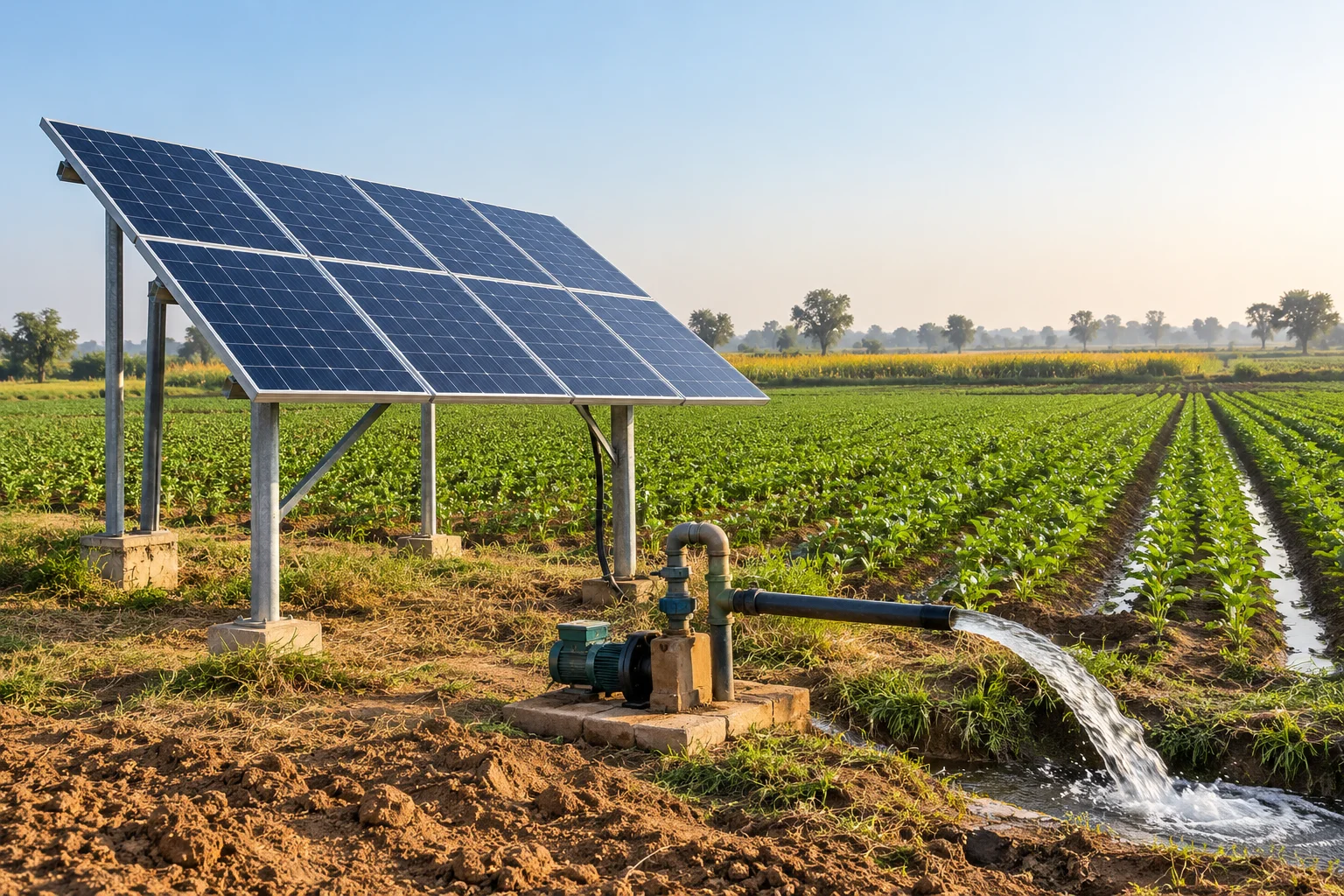
Solar infrastructure in an open agricultural landscape.
On-site and larger project enquiries
Land, layout and connection assessment
Site-specific EPC and maintenance scope
Start with the right questions

A solar farm begins with the right questions about the land.

Ground-mounted solar places the array on a dedicated support system rather than an existing roof. It can suit business premises with spare space or larger energy projects with an appropriate land and connection arrangement. Having an available plot is a useful beginning, but it does not establish that the project is technically or commercially viable.

Before settling on capacity, consider who will use the electricity, how the site connects to the network and whether the proposed land use is permitted. A provider can then scope surveys, design and approvals. SolarQuery helps organise your enquiry and looks for relevant independent businesses. The feasibility advice, engineering work, construction agreement and project payments are handled directly between you and the provider you select.

What to include in the brief

A clear scope makes better conversations.

Choose the work you need, then agree the exact responsibilities with your provider.

01 / SCOPE

Initial site feasibility

Describe the plot location, approximate area, current use and intended electricity consumer. Ask the provider to identify early constraints before commissioning detailed design, including access, existing services, boundaries and the likely connection route.

02 / SCOPE

Topography and ground assessment

Appropriate surveys help the engineering team understand levels and ground conditions. The foundation proposal should be supported by site information rather than copied from another project with different soil, slope or exposure.

03 / SCOPE

Array and access layout

A useful layout balances panel rows with maintenance routes, equipment areas and practical access. Ask to see how shading between rows, site boundaries and future service work have been considered in the usable area.

04 / SCOPE

Foundations and civil works

Clarify responsibility for foundations, grading, drainage, fencing and internal routes. The quote should identify assumptions and provisional items so unexpected ground conditions do not become an unexplained change to the agreed project price.

05 / SCOPE

Electrical and grid coordination

Generation equipment is only part of the electrical scope. Confirm the proposed connection point, cable routes, transformers where needed, protection and studies. Network approvals and connection works can materially affect the project schedule.

06 / SCOPE

Commissioning and asset care

Agree acceptance checks, as-built documentation and the transition into maintenance. Include monitoring, fault response, vegetation management and access for cleaning. A plant that is easy to maintain is a more practical asset to operate.

Have a project in mind?

Tell us the location and the work required. Our team can help turn it into a clear enquiry.

Discuss my requirements
Different sites. Different priorities.

Find the approach that fits your project.

On-site business generation

Use suitable land at or near your facility to support its energy needs. The assessment should connect the plant size to the actual consumer load and approved electrical arrangement, rather than treating land capacity as the only limit.

Fixed-tilt ground-mounted arrays

Panels sit at a designed angle on stationary supports. Ask the engineer to compare layout, foundations, shading and maintenance access for your site. A familiar mounting format still needs a project-specific structural design.

Tracking or specialist layouts

Tracking systems and elevated arrangements can be evaluated where the site and project justify them. Compare additional equipment, maintenance and civil requirements against modelled generation benefits; they are not automatically the best choice for every plot.

Solar engineers discussing a roof layout and project drawings.

A useful proposal connects the work, the site conditions and the responsibilities in writing.

Before you commit

The details worth discussing.

Confirm the right to develop the site

Resolve ownership, lease tenure, boundaries and applicable permissions before committing to construction. Get appropriate advice on land and contractual matters. SolarQuery does not validate title or grant development rights, and a provider enquiry is not a land-use approval.

Study water movement

A dry-looking plot can behave differently in monsoon conditions. Ask about flood history, drainage paths and erosion control. The layout and civil design should consider how water moves across and beyond the property, alongside access after heavy rain.

Check connection feasibility early

The nearest visible power line is not proof of an available connection. Ask the provider to explain the proposed route, required studies and responsible authorities. Keep connection assumptions visible in the programme and commercial assessment until they are confirmed.

Plan for the whole operating site

Think about security, cleaning access, vegetation, spares and staff visits before finalising the layout. Identify who maintains each part of the site, including drainage and fencing. Those responsibilities should not disappear between the construction handover and maintenance contract.

Cost and scope

Understand what shapes the quotation.

Ground-mounted solar needs a site-based quotation. Two similar-capacity projects can differ substantially because of ground conditions, civil scope and the network connection. Ask providers to distinguish confirmed work from allowances and exclusions, and review the ongoing operating assumptions before making an investment decision. A preliminary land enquiry cannot establish a reliable project return.

  • Usable area, site levels, soil conditions and foundation design
  • Land arrangement, access, drainage and other civil works
  • Capacity, mounting approach and electrical equipment specification
  • Connection distance, approval requirements and operating scope
From enquiry to provider conversation

A straightforward way to get started.

01 / YOUR REQUIREMENT

Tell us about the work.

Share the service, project PIN code and a short description. You can say you are unsure about the technical details.

02 / A CLEARER BRIEF

We confirm the details.

Our team follows up to understand the site and collect the information needed for a relevant provider enquiry.

03 / YOUR CHOICE

Discuss the next step.

We check for relevant local providers. If an introduction is possible, you compare the proposal and decide whether to proceed.

Tell us what you need

Let’s make the next step clear.

You do not need a finished specification. A few details help our team understand the job and check for suitable providers in your area.

  • Site PIN code and a location reference
  • Approximate area, boundaries and current land use
  • Ownership or lease position and available survey records
  • Intended electricity use and any existing connection details
  • Project stage, target capacity if known and preferred timetable
A homeowner couple discussing a rooftop solar project with an adviser.

Free to enquire. You choose whether to accept a provider’s proposal. Project scope, contracts and payments are agreed directly with your chosen provider.

Enquire about ground-mounted solar

  1. 1 Your project
  2. 2 Verify your mobile

All fields are required. We’ll follow up to confirm your requirements.

Explore the market

Service providers to explore.

A starting point for understanding the types of businesses working in this field.

These independent companies describe relevant services on their own websites. They are not a ranking or a list of confirmed SolarQuery partners. Check project size, location, service scope and current availability directly. For a SolarQuery introduction, send your requirement to our team.

Brand names are mentioned for information only; SolarQuery is not affiliated with these companies unless stated.

Tata Power

Its official EPC portfolio includes ground-mounted solar projects in India, covering engineering, procurement and construction. Suitable project size and local scope require confirmation.

India; project-specific availabilityView company service information (opens in a new tab)

Waaree Renewable Technologies

Offers ground-mounted solar EPC within its renewable-energy services and publishes Indian project examples. Contact the company to discuss site feasibility and project eligibility.

India; project-specific availabilityView company service information (opens in a new tab)
Questions before you enquire

A little more clarity.

These answers can help you prepare. Your provider should confirm the details for your property and the work required.

Ask about my project
How much land do I need for a ground-mounted solar plant?

There is no useful single answer for every site. Required area depends on the equipment, row spacing, terrain, setbacks, access and associated electrical infrastructure. Share the plot details first and ask for a preliminary layout. A land-area rule of thumb should not replace an engineered capacity assessment.

Can a small business install ground-mounted solar?

A project does not have to be a utility-scale solar farm to use ground mounting. A business may consider available land when its roof is unsuitable or insufficient. Feasibility depends on the site, electricity requirement, permissions and connection arrangement, so discuss these together before choosing a capacity.

Are solar trackers better than a fixed structure?

Trackers can change the generation profile, but also introduce moving equipment and additional design and maintenance needs. Ask the provider to compare options using the same site and commercial assumptions. The right answer depends on terrain, resource, land use, maintenance capability and the value of additional energy.

Can I lease my land for a solar project through this enquiry?

You can describe a potential site, but this enquiry does not guarantee a developer, lease offer or project approval. Make the ownership position and intended arrangement clear. Any lease, land verification, legal advice and development agreement must be handled separately with the relevant parties before work proceeds.

What should a ground-mounted solar EPC quote include?

Ask for design scope, equipment specifications, civil works, foundations, electrical infrastructure, approval responsibilities, commissioning and exclusions. Clarify whether surveys, land preparation, network works and maintenance are included. Payment milestones should be linked to agreed deliverables, and any performance commitment should explain its conditions and measurement method.

Further reading and service information

Brand names are mentioned for information only; SolarQuery is not affiliated with these companies unless stated.

Services by location

Illustrative service areas · availability unconfirmed